Designing Confidence Thresholds Operators Actually Trust
Automation earns trust by knowing when to stop. Practical patterns for setting thresholds from a cost matrix, routing edge cases to the line operator, and capturing every override as training signal.
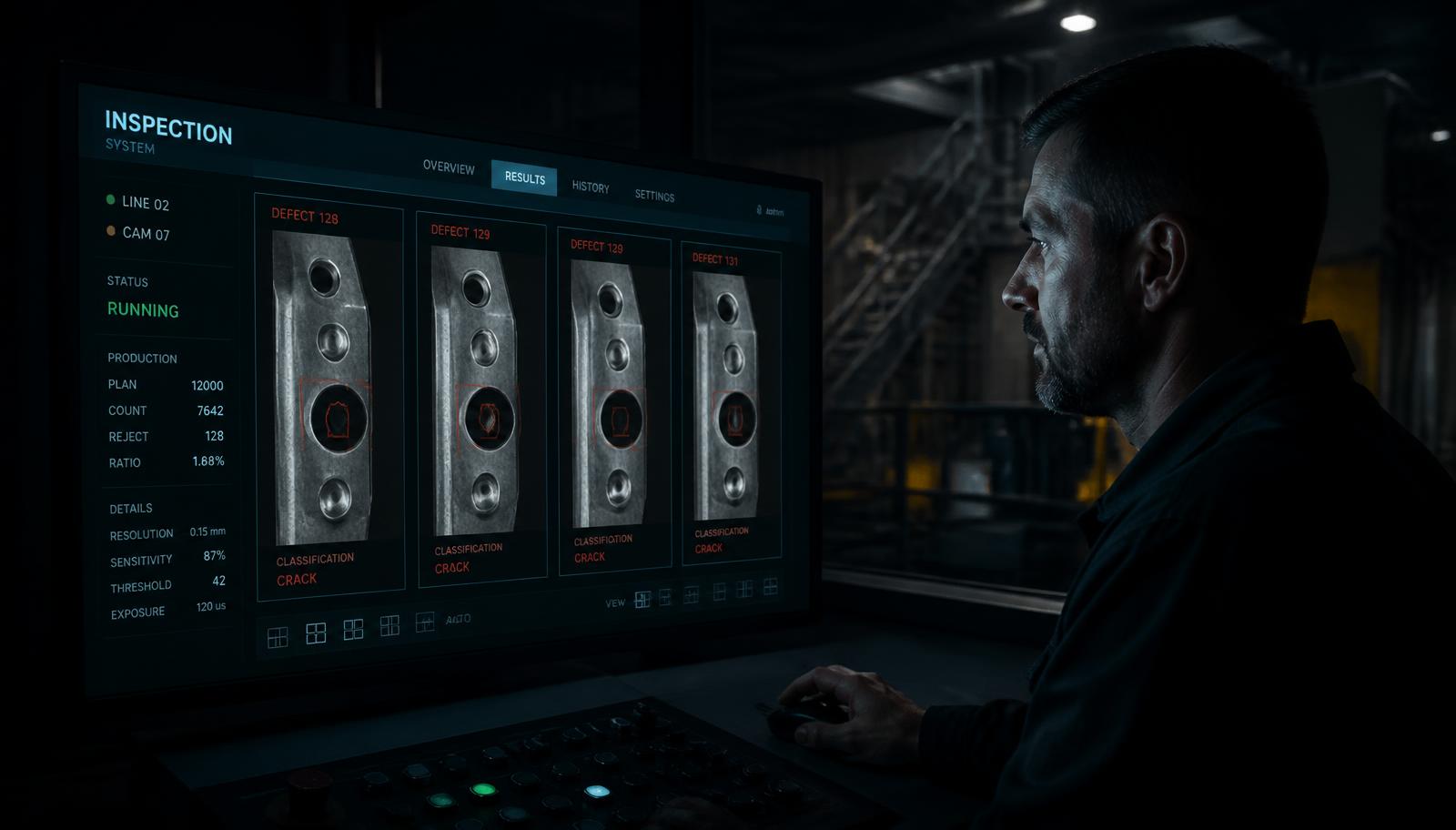
Every deployed inspection system eventually meets an input it should not decide on alone: a part type introduced last week, a reflection nobody modelled, a batch of material from a new supplier. The design question is not whether a human is involved, but how cheap the handoff is when it happens.
Systems lose operator trust in one specific way. They are confidently wrong, twice, in front of a shift lead. After that, the line runs with the vision system in advisory mode forever, and the investment quietly stops paying back.
Derive thresholds from the cost matrix
A threshold of 0.5 is a default, not a decision. Write out what a false negative costs and what a false positive costs, in the customer's currency. On a medical-device component line, a missed crack can cost a hundred times more than a spurious reject, so the escalation band should be wide and unapologetic. On a high-volume packaging line where a reject is a discarded carton, the balance inverts.
- Auto-accept above the upper bound, auto-reject below the lower bound
- Route the band between them to an operator queue with a target review time
- Size the band so the queue matches real staffing, not an ideal one
- Re-derive the bounds quarterly; material, tooling, and supplier mix all drift
Give the operator a diff, not a raw frame
Review time collapses when the context is pre-assembled. Show what the system saw, what it proposed, which region drove the score, how this part compares to the last twenty accepted parts, and how confident the model was. An operator who must hunt for the defect will approve everything within a week.
A two-second decision with full context beats a thirty-second decision with a raw image, and it is far more accurate.
Treat every override as labelled data
Operator corrections are the highest-quality training signal in the building, and they arrive for free if the interface is built to capture them. Log the frame, the model output, the human decision, the operator identity, and the timestamp. Six months of that is a better retraining set than anything you can buy.
Watch the override rate per class as a health metric in its own right. A class whose override rate climbs from 3 to 11 percent over a month is telling you the process changed before any drift detector does.
Make escalation auditable
In regulated plants, the question is never only "was it right", it is "can you show who decided". Store the decision chain as an append-only record: model version, engine build, threshold configuration in force, and the human who confirmed. That record is also what lets you replay an incident instead of theorising about it.
Automation that knows its limits gets expanded. Automation that hides them gets switched to advisory mode and forgotten.
Facing this in your own pipeline? Bring the stream specs and we will scope the audit.
Discuss a WorkflowRTSP Streams That Don't Drop Frames
Most industrial vision projects fail at ingestion, not inference. A field guide to stable multi-camera decoding, bounded queues, and the reconnect logic nobody writes until a night shift burns them.
11 JUL 2026INT8 Quantization Without Losing the Accuracy You Paid For
TensorRT calibration is not a checkbox. How to choose calibration data from the factory floor, which layers to keep in FP16, and how to prove the quantized model still catches the defect that matters.